The Yarn Swift That Turns a Twisted Skein Into a Ball You Can Knit From
An umbrella swift on an iron skeleton. It clamps to a table edge, opens to 21.65 in (55 cm) across, spins as you pull, and folds flat when the project is done.
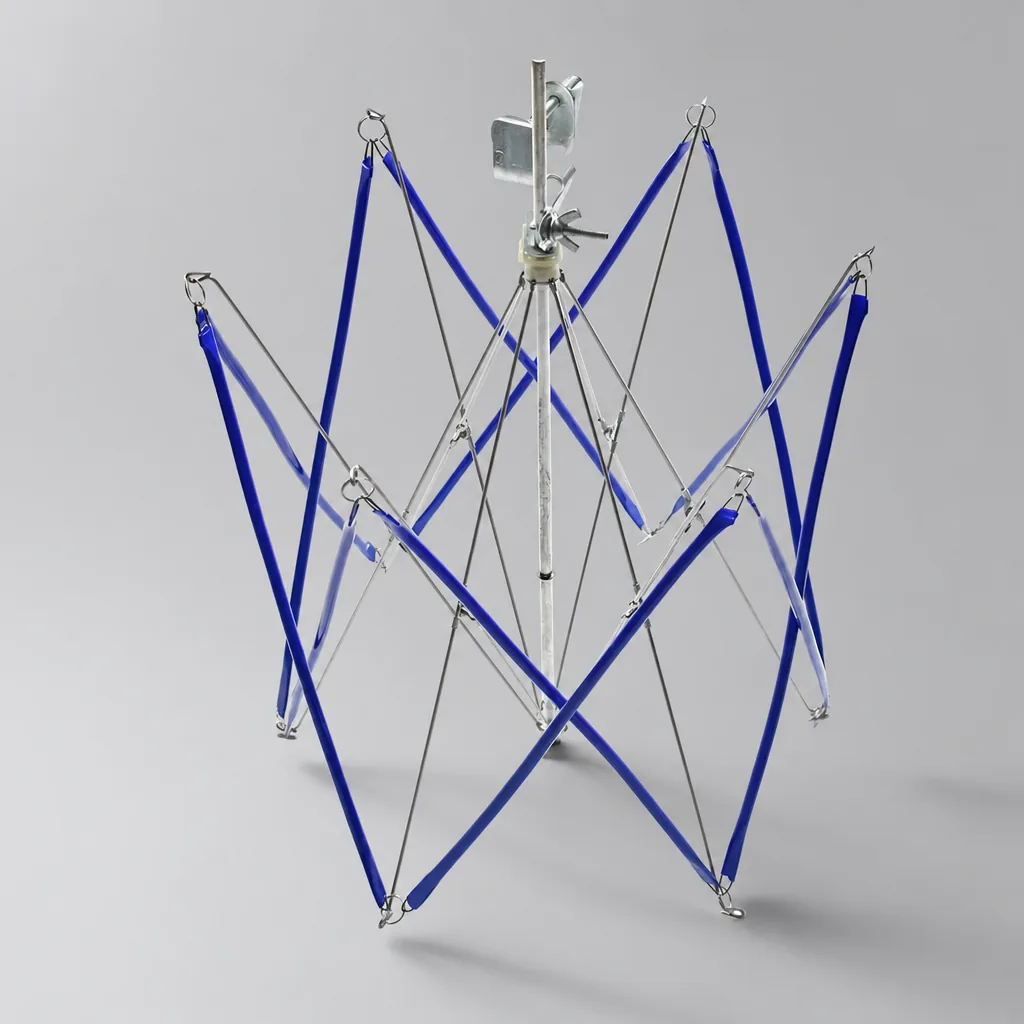
Prices in USD. The swift is $39.95 instead of $59.95 while this run lasts. Full detail on the umbrella swift page and the ball winder page.
A skein is not a ball, and pretending otherwise costs you an evening
Most people meet the problem the same way. You buy a beautiful hand-dyed hank at a fibre show, get it home, untwist it, and discover it is a single continuous loop about five feet around. You drape it over the back of a dining chair because that is what the internet suggested. Twenty minutes later the loop has slipped sideways, half of it is on the floor, and two strands have crossed and locked. Now you are not knitting, you are performing surgery.
The chair back fails for a mechanical reason, not because you did it wrong. A skein wants to feed from a frame that turns. A chair does not turn, so every inch you pull has to drag the whole loop across the wood. That drag is what pulls the far side of the loop out of place, and once one strand slips under another the tangle is already made. A swift removes the drag entirely because the frame itself rotates on a central pivot.
The umbrella design solves a second problem at the same time: skeins are not all the same size. A fixed frame only suits one circumference. The umbrella mechanism opens and closes like the frame of a real umbrella, so the arms move outward until they take up the slack in your particular hank and then stop. Small sock skeins sit on a tight setting, generous worsted hanks sit wide.
There is a quieter benefit that nobody mentions until they own one. Winding stops being a chore you postpone. Plenty of knitters have a bag of hanks they have not touched for months, not because they do not want to knit them, but because winding by hand takes forty minutes of concentration and produces a lopsided ball. With a swift clamped to the table, the same hank takes a few minutes, and a stash stops being a backlog.
If you are still deciding whether the swift, the winder, or both belong on your table, the comparison further down this page lays out what each tool actually does, and the swift and winder set page covers the pair in more detail.
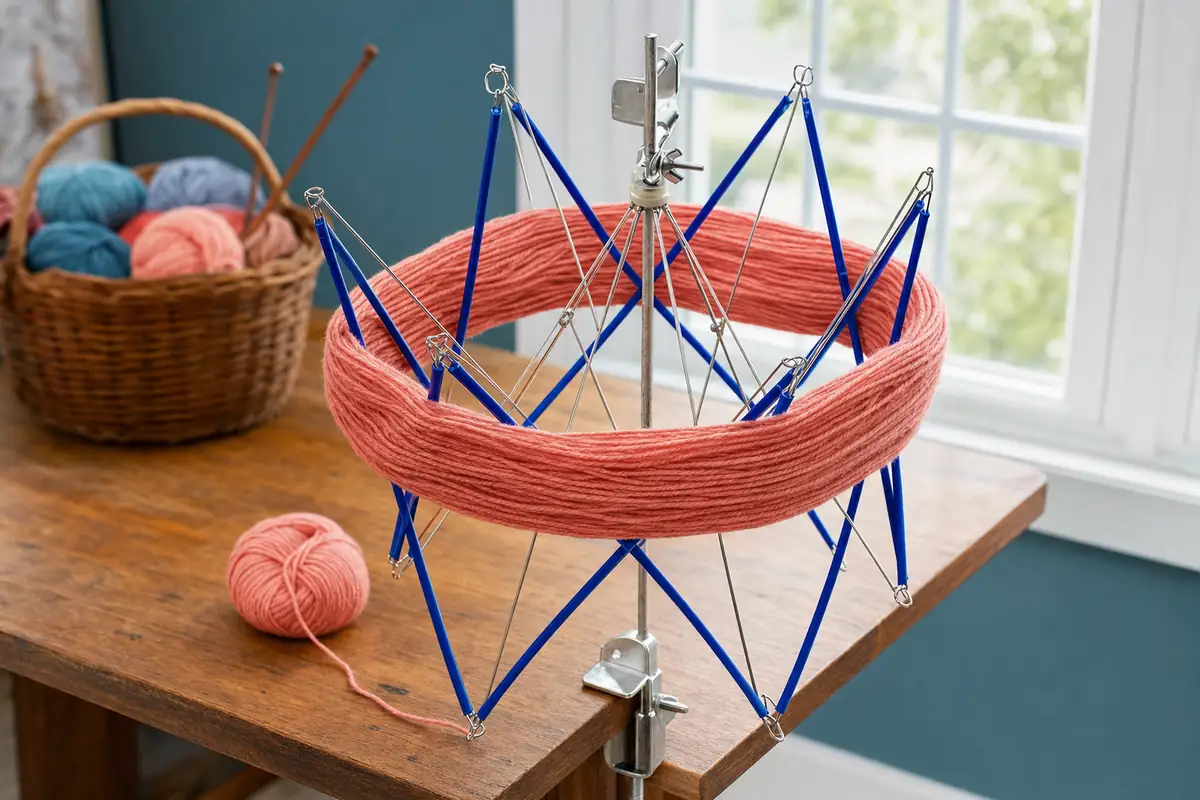
Three things this swift does that a chair back never will
It turns, so the yarn never drags
The frame spins on a central pivot. Pulling the strand rotates the whole assembly instead of dragging the skein across a surface, which is the single mechanical reason a swift prevents tangles rather than merely reducing them.
Rotation also means you control the pace. Pull slowly and it creeps. Pull at winding speed and it keeps up. Because the arms hold the loop at a fixed circumference, tension stays even from the first yard to the last, so the ball you end up with is packed the same way all the way through.
An iron skeleton under the finish
The structural parts are iron. Plastic appears only as bushings at the pivot points, where a little give is what stops metal grinding on metal. This is not a moulded plastic frame with a metal-look coating.
Why it matters: the arms of a swift carry a sideways load every time you pull, and a frame that flexes under that load lets the skein creep off the ends. Iron does not flex at this scale. The blue you see on the arms is finish over the metal, not the material itself.
It clamps down, then disappears
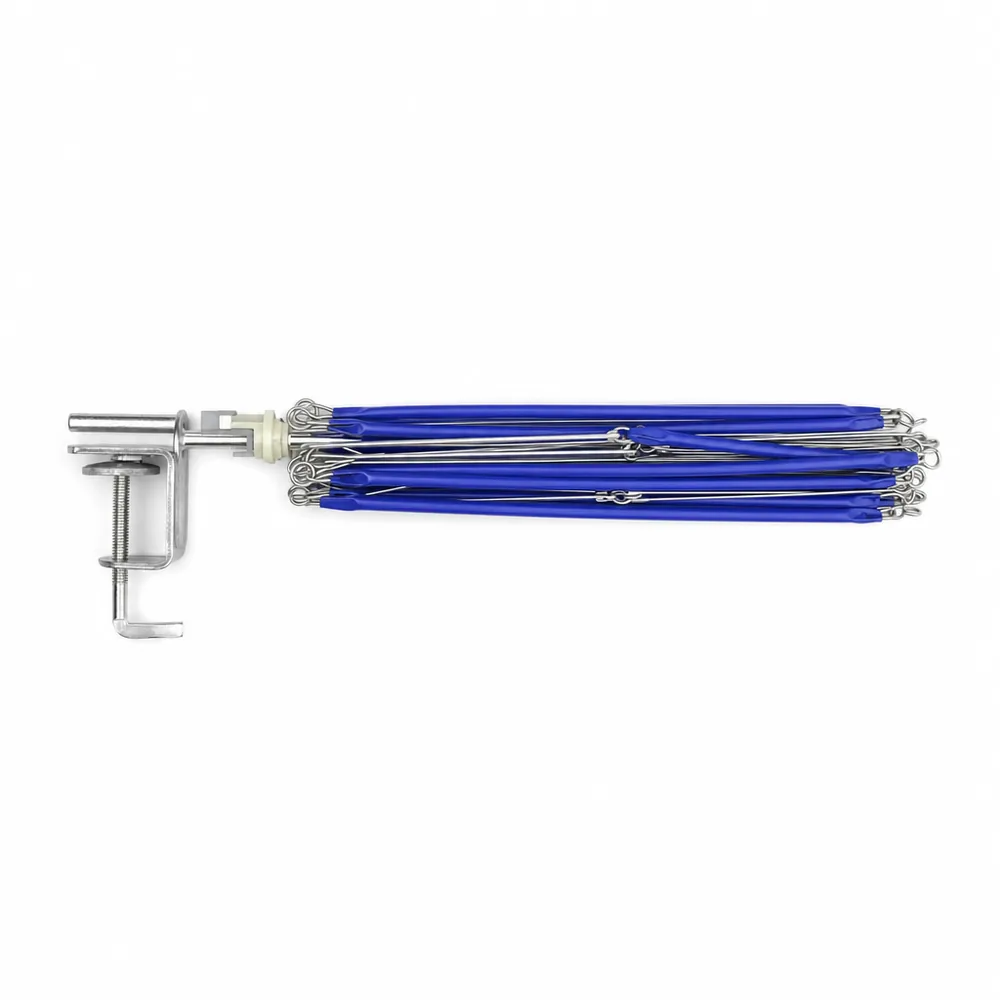
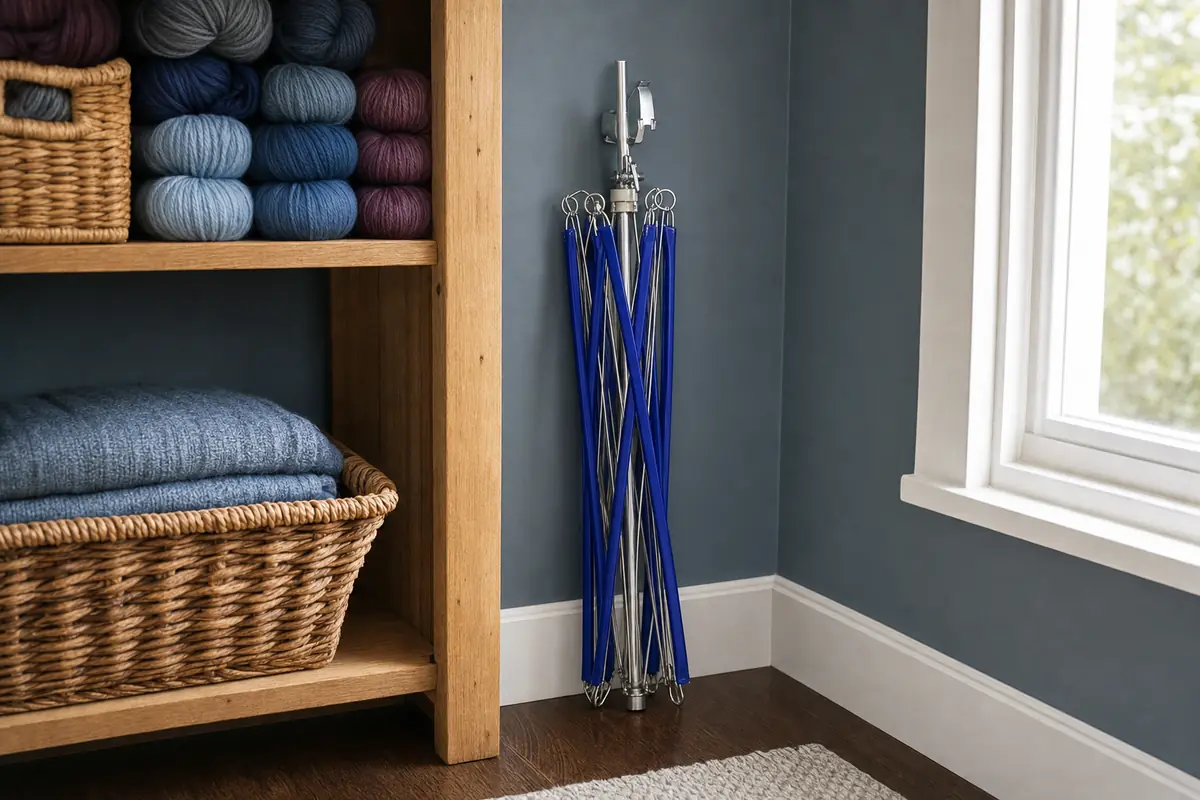
A screw clamp fixes the swift to a table edge in seconds, and the umbrella frame folds flat afterwards. There is no base, no stand and no floor footprint to find room for between projects.
That is the practical argument against the beautiful wooden floor-standing swifts. They are lovely and they live in the corner of the room forever. This one lives in a drawer, comes out for twenty minutes, and goes away again, which is why it suits a flat rather than a dedicated craft room.
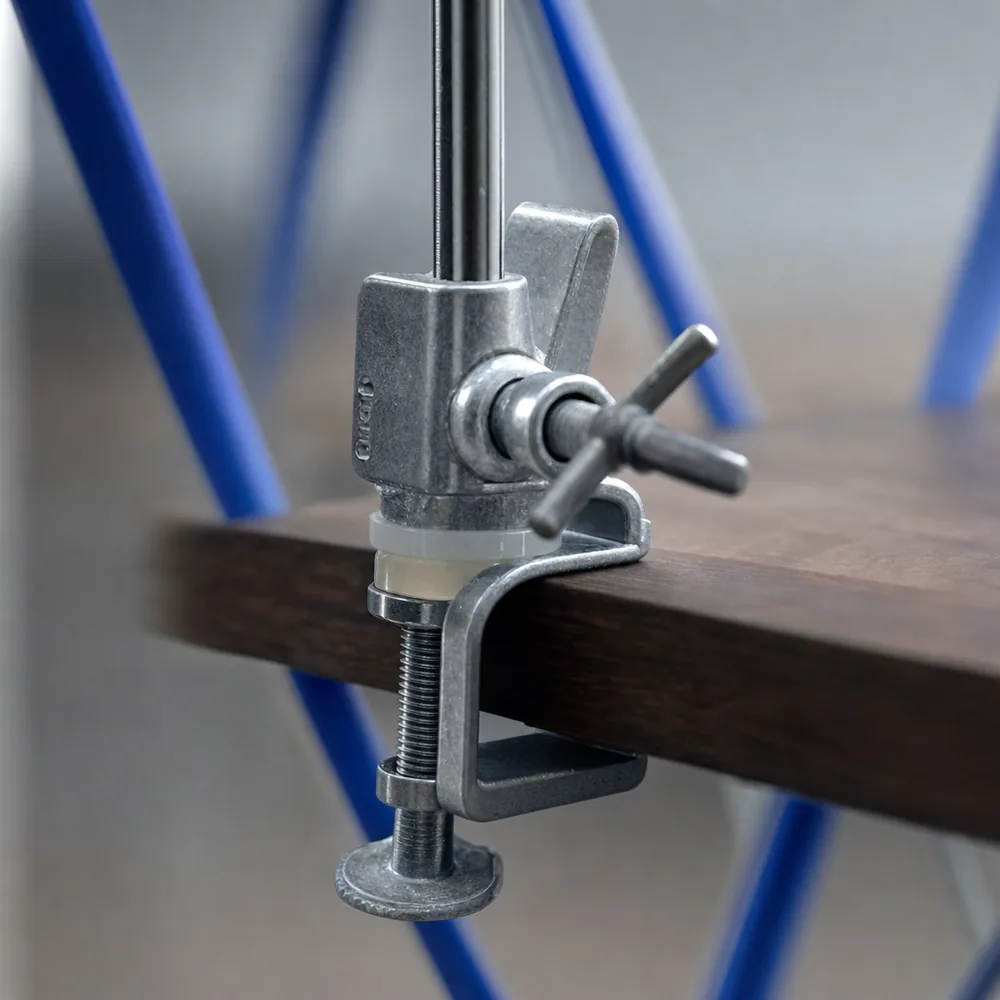
From clamp to first stitch in four steps
Clamp it to a bare table edge
Pick an edge with a clean flat lip, not a rounded moulding, and turn the screw until the jaw is firm under hand pressure. If the surface is delicate, fold a tea towel over the edge first. A swift that shifts under load is nearly always a swift that was clamped on a curve.
Open the arms to your skein
Untwist the hank into its natural loop and lay it over the arms. Push the umbrella mechanism outward until the loop is held taut but not stretched. You want it firm enough that the loop keeps its shape and loose enough that a strand lifts freely off the top.
Find and cut the ties
Most commercial hanks are held by two to four short ties of scrap yarn, and one of them usually secures both ends of the skein. Find the ends first, then cut every tie. Cutting before you find the ends is the single most common way a good skein becomes a bad afternoon.
Wind, do not yank
Feed the end to your ball winder or to your hand, and pull at a steady pace. The swift should turn with you. If it stutters, the arms are too wide. If the loop sags off an arm, they are too narrow. Adjust once and the rest of the skein runs without another thought.
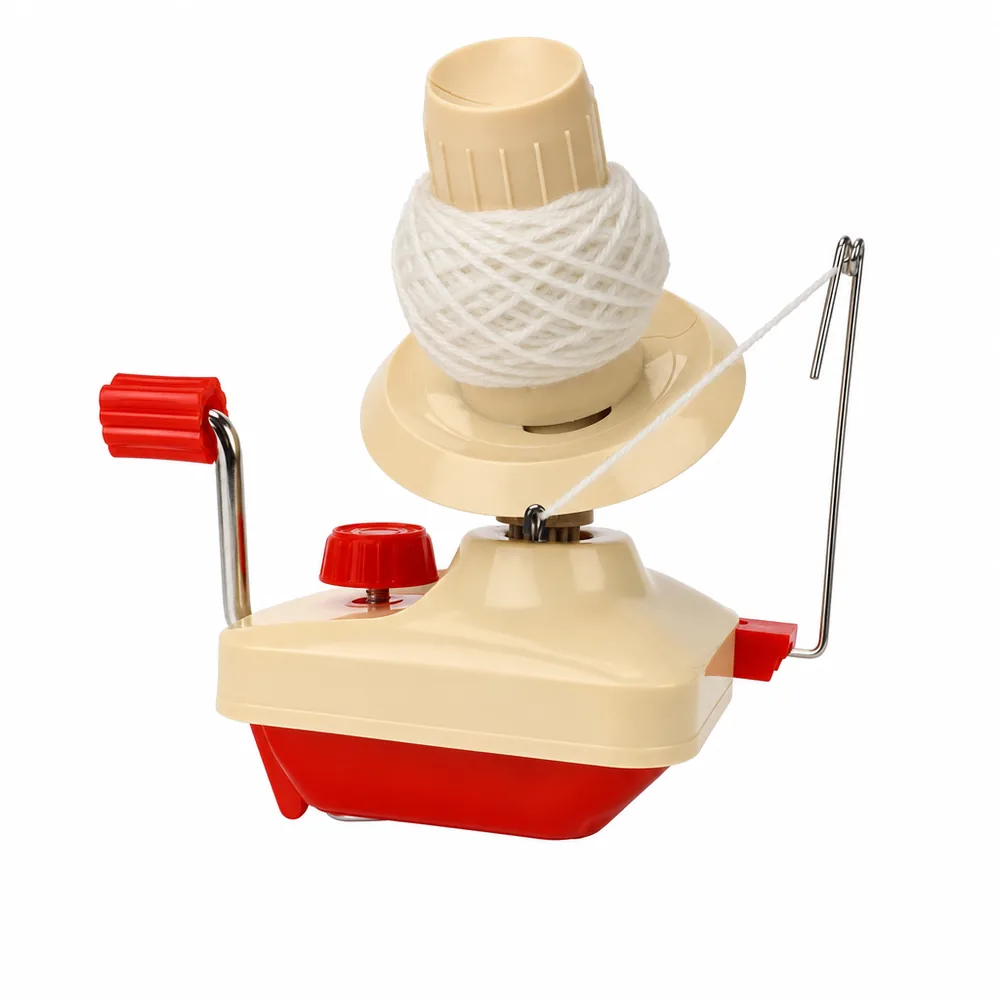
The swift holds the skein. The ball winder is what empties it.
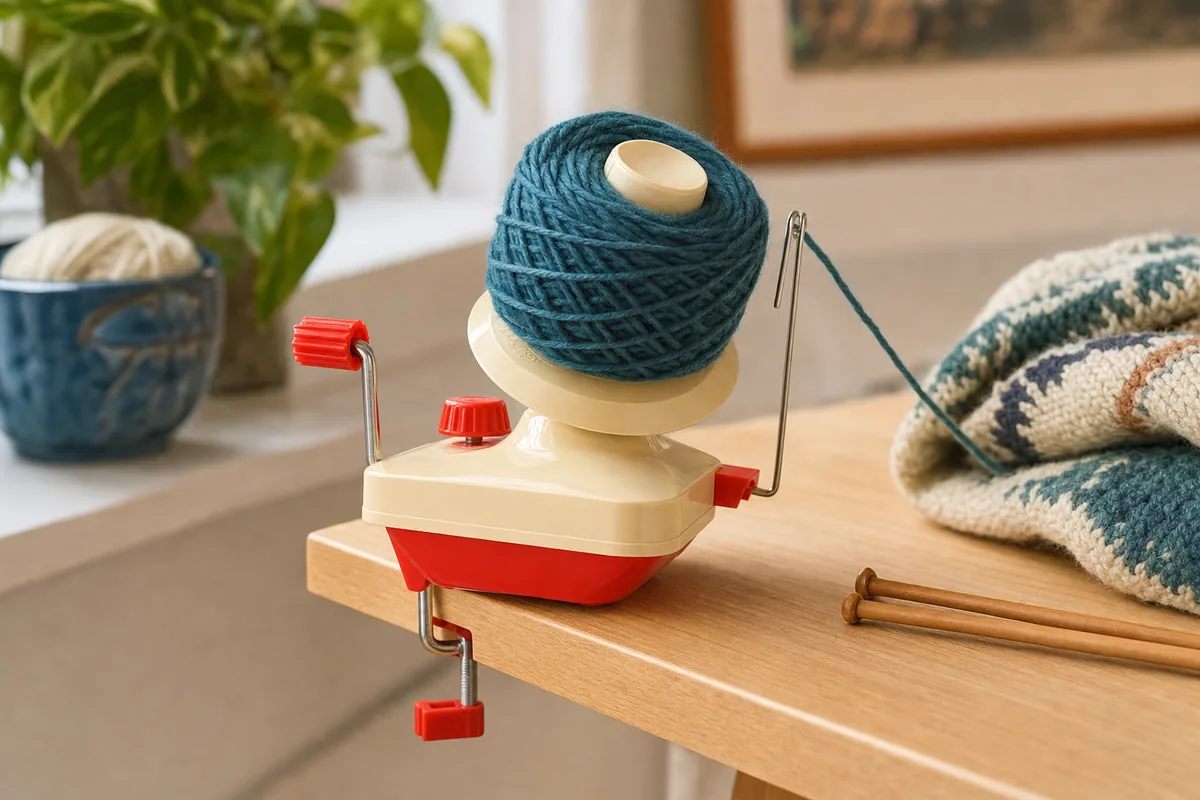
Wind by hand from a swift and you get a decent ball in perhaps fifteen minutes, with a thumb that aches and a ball that pulls from the outside, so it rolls off the sofa and under the radiator. Wind with a hand-crank ball winder and you get a flat-topped centre-pull cake in a couple of minutes that sits still and feeds from the middle.
The winder we sell is a hand-crank unit, 7.48 in (19 cm) tall, 5.35 in (13.6 cm) long and 3.54 in (9 cm) wide, in a cream body with red details. It clamps to the same table edge as the swift, ideally on the opposite side so the yarn has a clear run between the two. Its parts are named plainly on the spec sheet: spindle, yarn guide, knob, geared base, handle and clamp. Assembly is one motion, the spindle drops into the geared base by lining up the notches and turns clockwise to lock.
If you already own a winder, buy the swift alone. If you own neither, the set exists precisely because buying them apart costs more. Full detail lives on the ball winder page, and the swift and winder set page compares the two ways of buying.
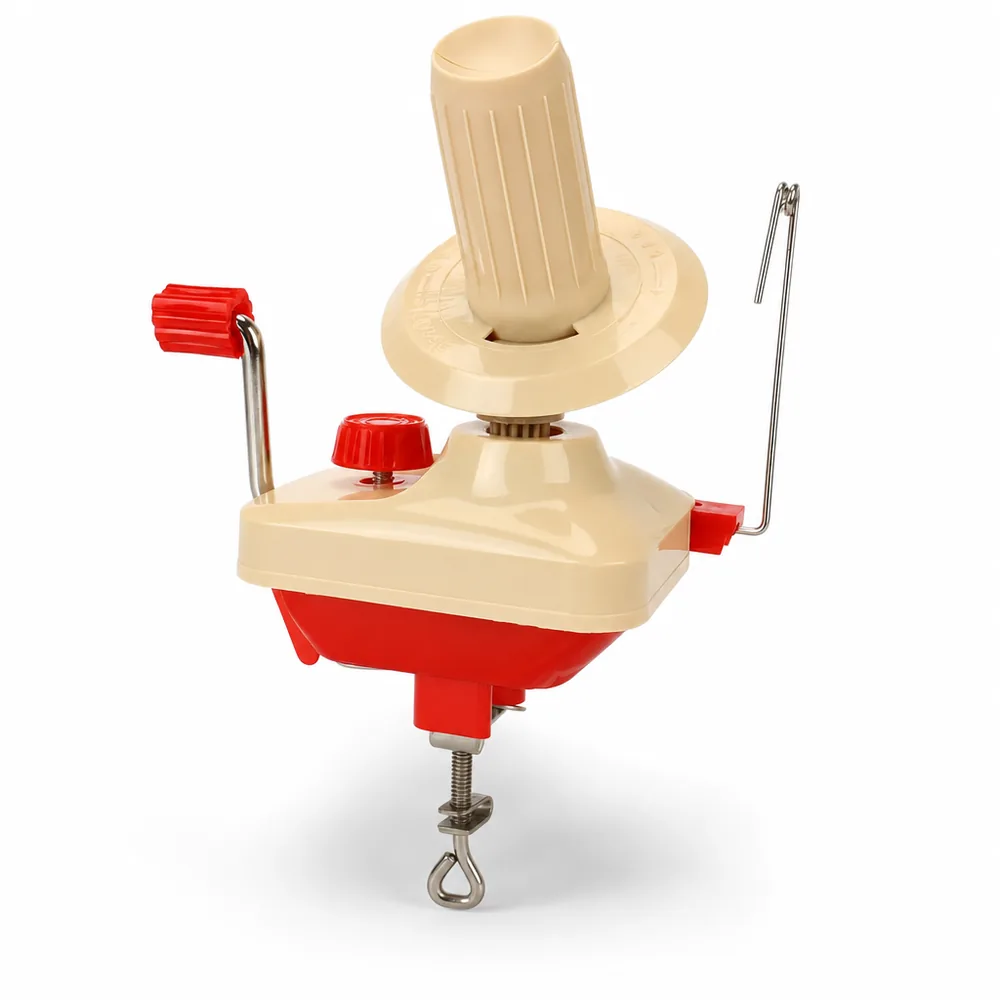
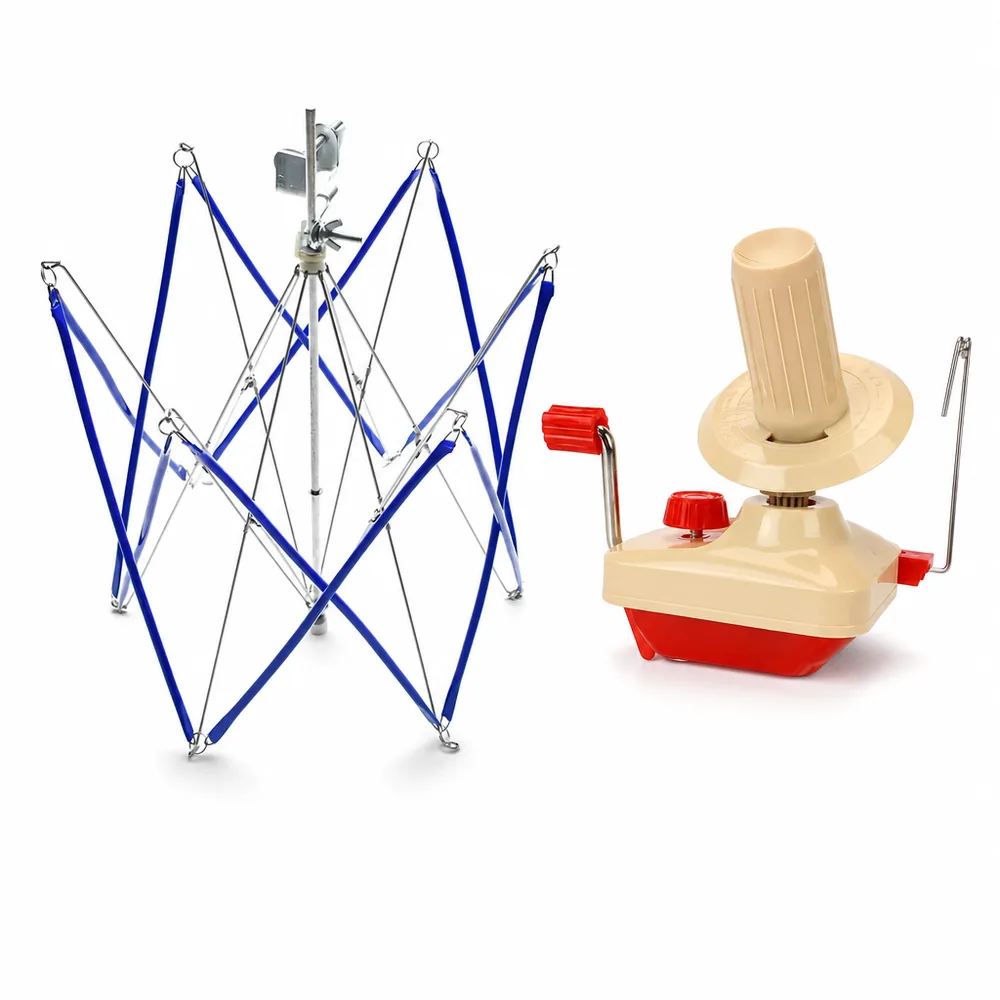
| Job | Swift alone | Winder alone | Swift plus winder |
|---|---|---|---|
| Holds a skein open without tangling | Yes | No | Yes |
| Produces a centre-pull cake | No | Yes | Yes |
| Handles a fresh hand-dyed hank end to end | Partly, by hand | No, needs a holder | Yes |
| Rewinds an existing ball that has collapsed | No | Yes | Yes |
| Price | $39.95 | $24.95 | $57.95 |
Every rating on both tools, and what we filtered out
Before listing these two products we exported the complete buyer rating history for each of them, not a sample. Then we applied one rule: we only carry forward ratings of 4 and 5 stars, and we tell you what was left out rather than quietly averaging it away. Here is the raw spread.
| Rating | Umbrella swift | Ball winder |
|---|---|---|
| ★★★★★ five stars | 25 | 261 |
| ★★★★ four stars | 1 | 24 |
| ★★★ three stars | 0 | 9 |
| ★★ two stars | 0 | 3 |
| ★ one star | 1 | 12 |
| Total collected | 27 | 308 |
| Kept and displayed on this site | 26 at 5.0 | 285 at 4.9 |
Source: complete buyer rating export, July 2026. Ratings come from verified purchases of these exact two products.
The interesting part is not the average, it is what the single one-star rating on the swift said. It described the clamp closing on itself. A separate five-star buyer, in the same set of ratings, wrote that the metal clamp is not superbly finished while still rating the tool at full marks. Two independent signals pointing at the same part is worth more than any average, so we say it here rather than hiding it in a review page: the clamp is the least refined part of this swift, it holds when it is tightened on a flat bare edge, and it is the thing to check first if the frame ever shifts under load.
The table above is the complete export, the single one-star rating included. Knowing which part to tighten first is what keeps the frame steady under load, and that part is the clamp screw.
The three figures behind this listing
verified buyer ratings kept on the umbrella swift, all of them 4 stars or better, averaging 5.0
— Complete buyer rating export, 2026
ratings collected on the hand-crank ball winder, of which 285 sit at 4 or 5 stars
— Complete buyer rating export, 2026
measurement tolerance the spec sheet itself declares on the swift dimensions, because units are measured by hand
— Specification sheet, 2026
That last figure is the one most stores would never print. It means the 21.65 in (55 cm) open width and the 16.54 in (42 cm) height are close, not exact, and that two units off the same line can differ by up to about an inch. For a tool whose job is to hold a loop of yarn, that variance changes nothing in use. For a page that claims to tell you the truth about a product, leaving it out would change quite a lot. You can read the rest of our method on the how we test page.
Umbrella swift, wooden swift or Amish-style swift: what actually changes
| Option | Frame material | Stores away flat | Adjusts to skein size | Typical look |
|---|---|---|---|---|
| This umbrella swift | Iron skeleton, plastic bushings | Yes, folds flat | Yes, umbrella mechanism | Workshop tool, painted finish |
| Wooden umbrella swift | Hardwood slats and pegs | Yes, folds flat | Yes, umbrella mechanism | Heirloom, warm timber |
| Amish-style tabletop swift | Hardwood arms on a turned base | No, keeps its footprint | Yes, sliding pegs | Traditional, decorative |
| Chair back or a second person | Not applicable | Yes | No | Does not rotate, so strands cross as you pull |
A wooden swift is quieter under the hand, and for many knitters it is an object they want visible in the room. Ours is built for the opposite job: a painted metal frame that comes out for a skein and goes away again.
Where this one wins: it survives being handled without care. A painted iron frame does not mark when it knocks a table leg, does not need conditioning, and does not mind a humid flat. It folds flat into a drawer between skeins, and it costs a fraction of a hardwood swift at $39.95.
Against a chair back there is not much of a debate. The chair holds the loop still, so every strand you pull travels across the ones it touches. The swift turns the whole loop together instead. Our own buyers put it more plainly than we can: one wrote that having this swift is like having a second pair of hands, which is precisely the job description.
Specifications, exactly as the spec sheet publishes them
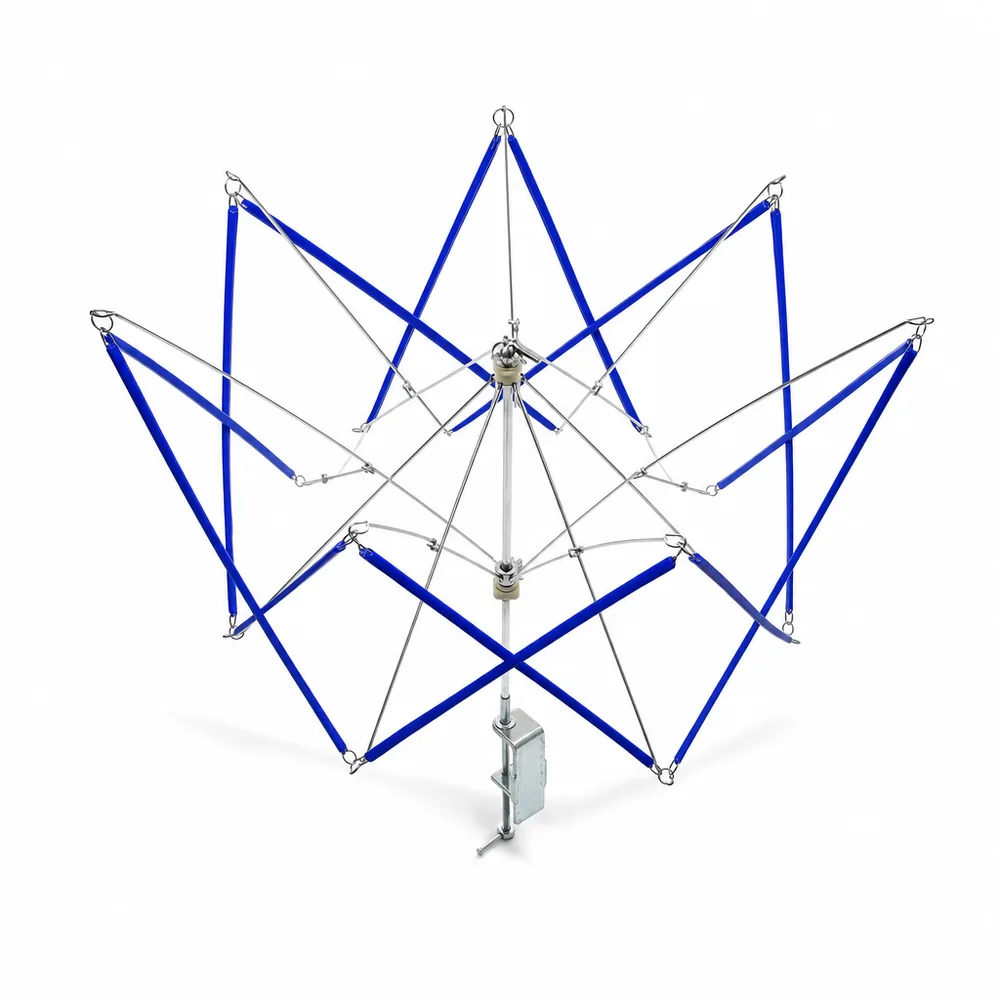
| Height | 16.54 in (42 cm) |
|---|---|
| Open width | 21.65 in (55 cm) across at full extension |
| Frame material | Iron skeleton with plastic bushings |
| Mounting | Screw-down table clamp |
| Storage | Folds flat |
| Measurement tolerance | 1 to 3 cm, declared on the spec sheet |
| Price | $39.95, was $59.95 |
What the 21.65 in (55 cm) open width means for your hanks
Every figure on this page comes from the spec sheet: the height, the open width and the declared measurement tolerance of 1 to 3 cm. Those are the numbers we can stand behind, so those are the numbers we print.
At 21.65 in (55 cm) across at full extension, this swift takes the commercial hanks that yarn is normally sold in, and the arms close down for smaller sock skeins. If your hanks are unusually large, measure the loop flat and compare it to that figure. If you are unsure, send us the measurement through the contact page and we will check it against the frame for you.
What is in the box and how it goes together
The swift arrives folded with its clamp attached. There is no assembly beyond opening the umbrella frame and turning the clamp screw. The ball winder, if you order it, comes in two main pieces: the spindle drops into the geared base by lining up the notches, and while you hold the base you turn the spindle clockwise until it locks. That is the entire assembly, described in the spec sheet's own words.
Both tools clamp the same way, so a single table edge can carry the pair if it is long enough. Most people put the swift on one end and the winder on the other, with a clear run of two or three feet between them.
Shipping, returns and where we ship
Shipping is free. Orders are processed in 1 to 2 business days and arrive in 6 to 10 business days in total. We ship to 4 countries, led by the United States, and the full list is published on the shipping policy page. Every order carries a 30-day money-back guarantee, set out on the refund policy page.
Rated 5.0 out of 5 across 26 verified ratings
These are ratings left by verified buyers of this exact swift, not rewritten and not borrowed from anywhere else.
"This works very well, it's like having another hand"
Verified buyer, Australia
"Works great. 8 days delivery."
Verified buyer, Czech Republic
"Just what I was looking for. Easy to use and good quality."
Verified buyer, Spain
Ratings come from verified purchases and are filtered to 4 and 5 stars. The complete distribution, including what we removed, is published in the table above and on our reviews page.
Written and reviewed July 2026. Our sourcing and rating rules are set out on the how we test page, and the story behind the shop is on the about page. Longer explainers live in the guides section.
Questions people ask before buying a yarn swift
What is a yarn swift and do I really need one?
A yarn swift is a rotating frame that holds a skein of yarn open while you pull from it. Without one, the skein has to sit on a chair back, a lampshade or somebody else in the room, and it collapses into a tangle the moment the tension changes. The swift turns instead of fighting you, so the strand feeds off evenly.
How big is this umbrella swift when it is open?
It stands 16.54 in (42 cm) tall and opens to 21.65 in (55 cm) across at full extension, measured on the spec sheet. The same sheet declares a measurement tolerance of 1 to 3 cm, because the units are measured by hand, so treat those figures as close rather than exact.
Is this swift made of wood?
No. The load-bearing skeleton of this swift is iron, with plastic bushings at the pivot points, and the blue is a finish on metal. Wooden and Amish-style swifts are a different category of product with a different price and a different look. The iron skeleton is what lets this one fold flat and live in a drawer between skeins.
Will the table clamp hold on my table?
The clamp screws down onto a table edge and holds well on a flat lip up to a normal tabletop thickness. Two separate buyers commented on the clamp finish rather than the clamp strength. Our advice is to tighten it firmly by hand on a bare edge, and to slip a folded cloth between the jaw and a delicate surface.
Do I need a ball winder as well as the swift?
You need both to finish the job. The swift holds the skein open, the ball winder pulls from it and packs the yarn into a centre-pull ball. The spec sheet describes the swift as a tool to use together with a winder, and that is exactly how the Swift plus Winder set is priced.
Can I use it with hand-spun or thrift-store skeins?
Yes, as long as the skein fits the frame when it is open. The arms adjust in and out along the umbrella mechanism, so smaller loops sit on a narrower setting and larger loops sit wider. What the swift cannot do is fix a skein that is already knotted through itself. That still has to be untangled by hand first.
How long does delivery take and what does shipping cost?
Shipping is free. Orders are processed in 1 to 2 business days and arrive in 6 to 10 business days in total. We ship to the United States and 17 other countries, and the full list is on our Shipping Policy page.
What happens if it does not work out?
You have a 30-day money-back guarantee. If the swift is not what you expected, contact us within 30 days of delivery and we refund the order. Returns are free. The full procedure, including what to do if something arrives damaged, is set out in our Refund Policy.
Clamp it on, open it up, and wind the stash
The umbrella swift is $39.95 instead of $59.95, the ball winder is $24.95, and the two together are $57.95. Free shipping and 30 days to change your mind.
Choose your set