Umbrella Swift: Opens to 21.65 in, Folds Flat, Clamps to Your Table
It is the tabletop half of the setup. Pair it with the hand crank ball winder and a commercial hank becomes a center-pull ball in minutes, or take both together in the swift and winder set.
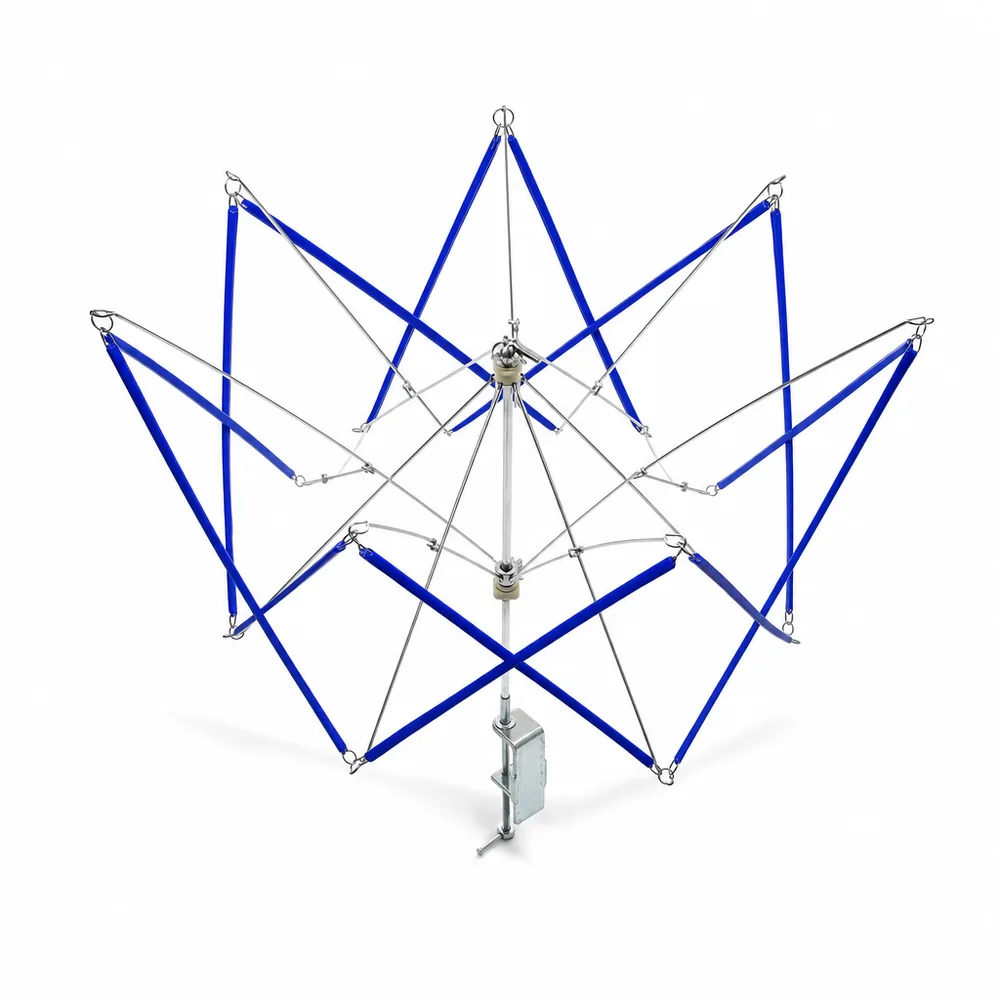
Why a yarn swift is built like an umbrella
Every yarn swift has to do the same thing: hold a loop of yarn open, turn freely as the strand is pulled away, and stop the loop from collapsing on itself. There are two established ways to build one. A cross-arm swift, sometimes called an Amish swift, uses two crossed wooden arms with pegs at the ends. An umbrella swift uses hinged ribs on a vertical shaft, exactly like the object it is named after. Both hold yarn. They differ in what happens when you have finished.
The cross-arm design has to stay open, or be unpegged and stored as loose parts. The umbrella design collapses in one movement, which is why it wins in a house with one table and no dedicated craft room. Loosen the clamp, let the ribs fall inward, and the swift goes behind a door. That is the entire argument for the shape, and it is a practical argument rather than a technical one.
The second consequence of the umbrella frame is that the diameter is not fixed. The ribs open progressively, so you spread them until the hank sits taut and no further. A small lace hank sits on a small circle; a fat worsted hank opens the ribs closer to their full 21.65 in (55 cm). You are not forced to stretch a short loop across a wide frame, which is exactly how a hank ends up snapping mid-wind.
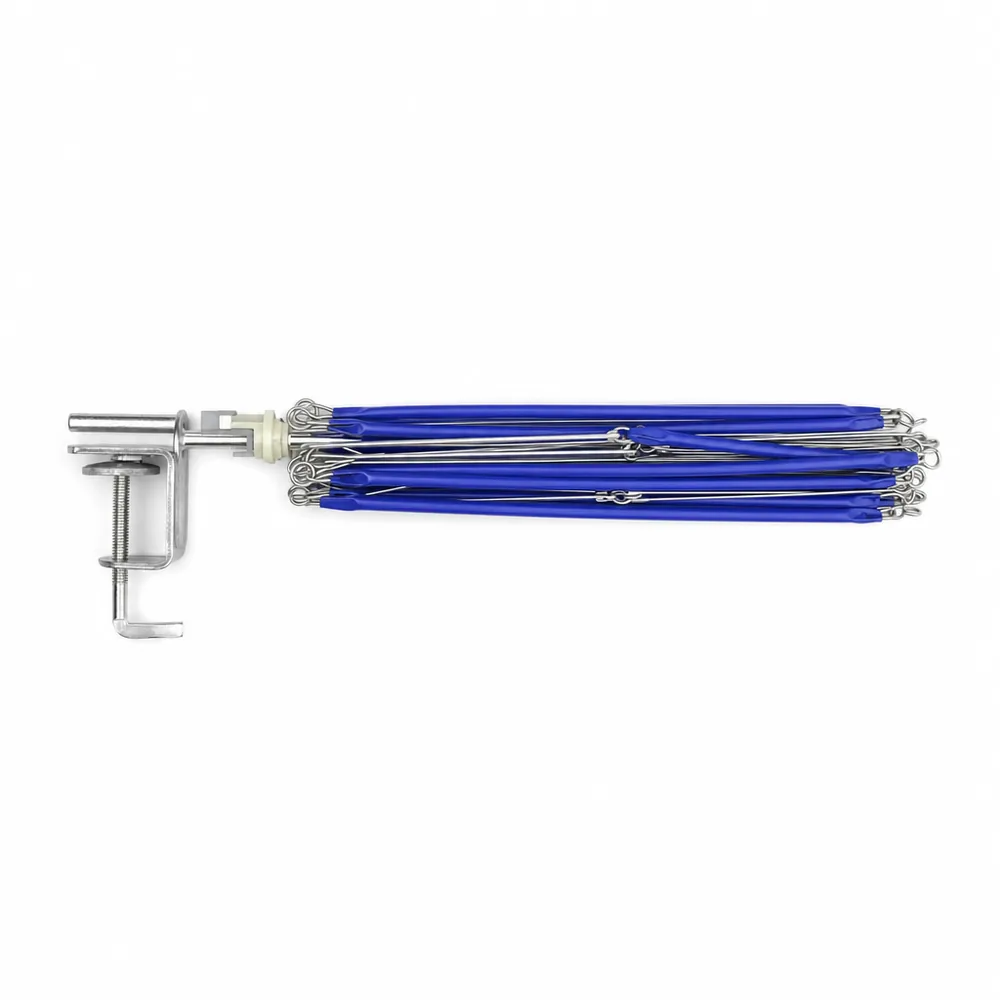
Diameter, clamp and the flat fold
Matching the diameter to the hank
Open the swift about halfway, drop the hank over the ribs, then keep opening until the loop stops sagging. Taut, not stretched. If the yarn is singing when you flick it, you have gone too far. The spec sheet publishes a measuring tolerance of 1 to 3 cm on the frame's dimensions, which is normal for hand-measured hardware and irrelevant in use, since you set the working diameter by eye against the hank in front of you rather than against a number.
The table clamp, honestly
The swift mounts on a screw clamp that grips a table edge from above and below. Tighten it more than feels necessary, then push the frame sideways to check it does not walk.
If your table edge is glossy or very thin, a folded reviews page collects the rest of what buyers said.
Folding and storing
Take the yarn off first. Then loosen the clamp, hold the shaft upright and let the ribs fall in toward it. Nothing has to be unscrewed, unpegged or taken apart, and there is no wood finish to protect from damp. It stores where a folded umbrella stores.
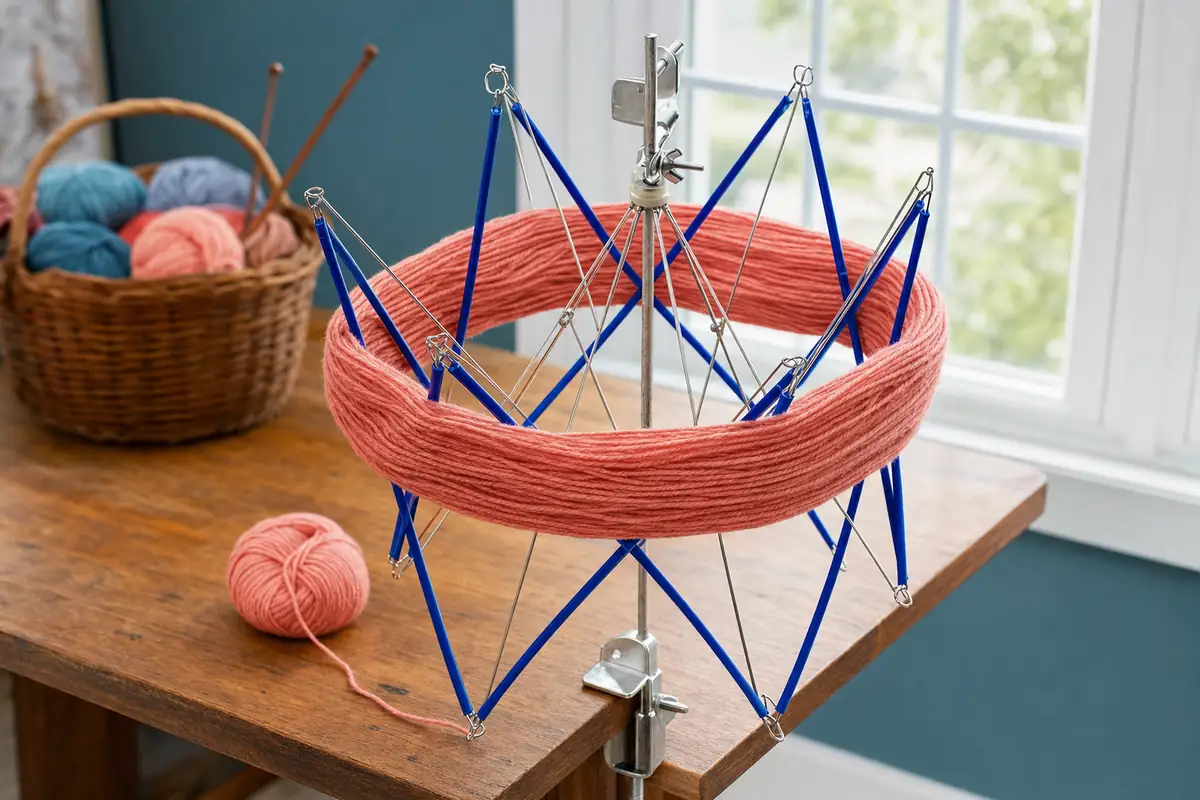
This swift against a turned-wood or Amish swift
We sell one of these two things, so read the table with that in mind. This swift is not wooden, it is not Amish-built, and calling it either would be a lie that a single photograph would expose.
| Skeinwright folding umbrella swift | Turned-wood or Amish style swift | |
|---|---|---|
| Structure | Iron skeleton with plastic bushings at the joints | Turned hardwood, frequently made by hand in small workshops |
| Open width | Up to 21.65 in (55 cm), set by how far you open the ribs | Varies by maker, often fixed by peg positions |
| Height | 16.54 in (42 cm) | Varies by maker |
| Storage | Collapses flat in one movement | Usually stays assembled or comes apart into loose pieces |
| Care | Wipe it clean, no finish to maintain | Wood benefits from occasional oil or wax and dislikes damp |
| Price | $39.95, or $57.95 with the winder | Typically sells well above a folding metal swift |
| Best for | Shared tables, small flats, people who put tools away | A dedicated craft space and buyers who want an heirloom object |
If what you want is a hardwood swift that your grandchildren will argue over, buy a hardwood swift. If what you want is to stop fighting a hank on the back of a dining chair this weekend, and to get the table back afterwards, this is the cheaper and more practical answer.
What 26 verified ratings actually say
This swift has a short rating history, and we are not going to dress it up. We read every four and five star rating attached to it, all of them written by buyers who had already received the product, and we grouped them by what they were actually about rather than by star count. Twelve are written in English and readable in full on our reviews page. Not one of them carries a usable photograph, so the swift's reviews are published as text only. That is unusual enough to say out loud.
| Theme | What buyers said | Our reading |
|---|---|---|
| Value for money | Repeatedly described as strong for the price | Consistent with a $39.95 metal swift, not with a workshop-built one |
| Doing the job | "This works very well, it's like having another hand" | The single clearest description of what a swift is for |
| Delivery | "Works great. 8 days delivery." | Matches the 8 to 10 business day window we publish |
| The clamp | Mentioned by two ratings, one of them five stars | The finish is basic. Tighten it properly and check it after the first hank |
Full disclosure on the clamp: the second mention came from a one-star rating that our four stars and up policy keeps off this site. We are flagging it anyway, because a buyer who hits the same issue deserves to have been warned rather than surprised.
The figures behind this listing
Full open diameter of the swift, 55 cm across the ribs
— Skeinwright specification block, 2026
Height of the frame, 42 cm, measured on the closed shaft
— Skeinwright specification block, 2026
Measuring tolerance the spec sheet declares on these dimensions
— Skeinwright specification block, 2026
Verified buyer ratings of four stars and up, averaging 5.0 out of 5
— Skeinwright audit of the rating history, 2026
We publish the tolerance because the spec sheet publishes it. Hand-measured hardware varies, and a shop that quotes 55 cm to the millimetre is quoting a number it did not verify. What we will not publish is a weight or a maximum hank circumference, because no such figure exists in the spec sheet and deriving one from the diameter would be arithmetic dressed up as a specification.
Everything the spec sheet publishes
| Height | 16.54 in (42 cm) |
|---|---|
| Open diameter | Up to 21.65 in (55 cm) |
| Structure | Iron skeleton with plastic bushings |
| Mounting | Screw table clamp |
| Folding | Ribs collapse inward, folds flat |
| Stated tolerance | 1 to 3 cm on hand-measured dimensions |
| Price | $39.95, or $57.95 in the set with the winder |
Shipping is free and takes 6 to 10 business days. Details of destinations, handling and returns are in our shipping policy and refund policy. Anything not listed above is not published by the spec sheet, and we will say so rather than estimate. Ask us through our contact page.
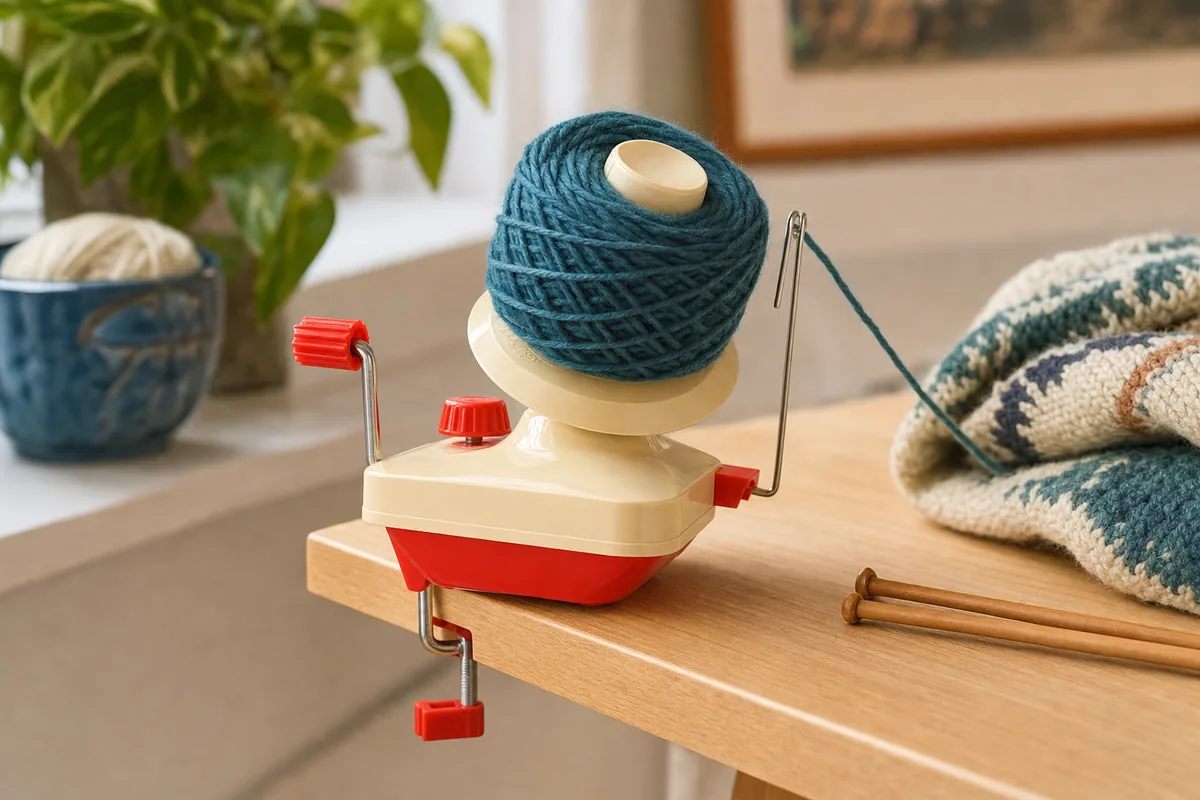
Umbrella swift questions, answered
What is an umbrella swift and why that shape?
An umbrella swift is a yarn holder built on the same ribbed frame as an umbrella. The ribs open outward to hold a hank in a wide circle and collapse inward to a narrow stick. That is the whole reason for the shape: one mechanism gives you both a wide working diameter and flat storage.
How wide does the Skeinwright umbrella swift open?
Up to 21.65 in (55 cm) across when the ribs are fully open, on a frame standing 16.54 in (42 cm) tall. You open it only as far as the hank needs, so a smaller loop sits on a smaller circle. The spec sheet states a measuring tolerance of 1 to 3 cm.
Is this swift made of wood?
No. The skeleton is iron with plastic bushings at the joints, and the visible blue parts are coated rather than raw material. Turned hardwood swifts, including Amish-built ones, are a different product with a different price. We compare the two honestly further up this page.
What kind of table edge does the clamp need?
Any edge the screw clamp can grip from above and below: a dining table, a desk, a counter overhang or a sturdy shelf. Tighten it firmly and check it again after the first hank. Two of the buyer ratings we read mention the clamp, which is why tightening it on a bare flat edge is the step to get right.
Does it fold flat for storage?
Yes. Loosen the clamp, let the ribs collapse inward and the swift closes to a narrow shape you can slide behind a bookcase or into a cupboard. That is the practical advantage over swifts that stay permanently assembled or have to be taken apart piece by piece.
Do I need a ball winder as well?
The swift holds the hank open, but something still has to wrap the yarn into a ball. The spec sheet describes the swift as a tool for unwinding a twisted hank for use with a winder. The pair is $57.95 as a set, against $94.90 for the two at full price.
The rest of the setup
Hand crank ball winder
The other half of the job. Clamps beside the swift, 7.48 in (19 cm) tall, and turns the open hank into a center-pull ball.
Swift and winder set
Both tools for $57.95, against $94.90 at full price. One order, one delivery, the complete skein to ball workflow.
Guides
Start with how to use a yarn swift, then read the rest of the library on opening hanks without a tangle.