Yarn Winder: The Hand Crank Ball Winder That Ends Tangled Skeins
The winder is the half of the job that shapes the yarn. Its partner, the umbrella swift, is the half that holds the hank open. Buy the winder on its own if your yarn already comes in a loose ball, or take the yarn swift and winder set if you work from twisted hanks.
What a yarn winder does that your hands cannot
The difference is not cosmetic. When you wind a ball by hand you wrap the yarn around your fingers or around itself, which means every new layer sits on top of the one below at the same angle. The ball gets tighter as it grows. Wool remembers that tension: it comes off the ball stretched, and the stitches it makes are a fraction narrower than the ones you swatched with. A winder lays each pass across the previous one at a changing angle, so the layers lock against each other rather than compress each other.
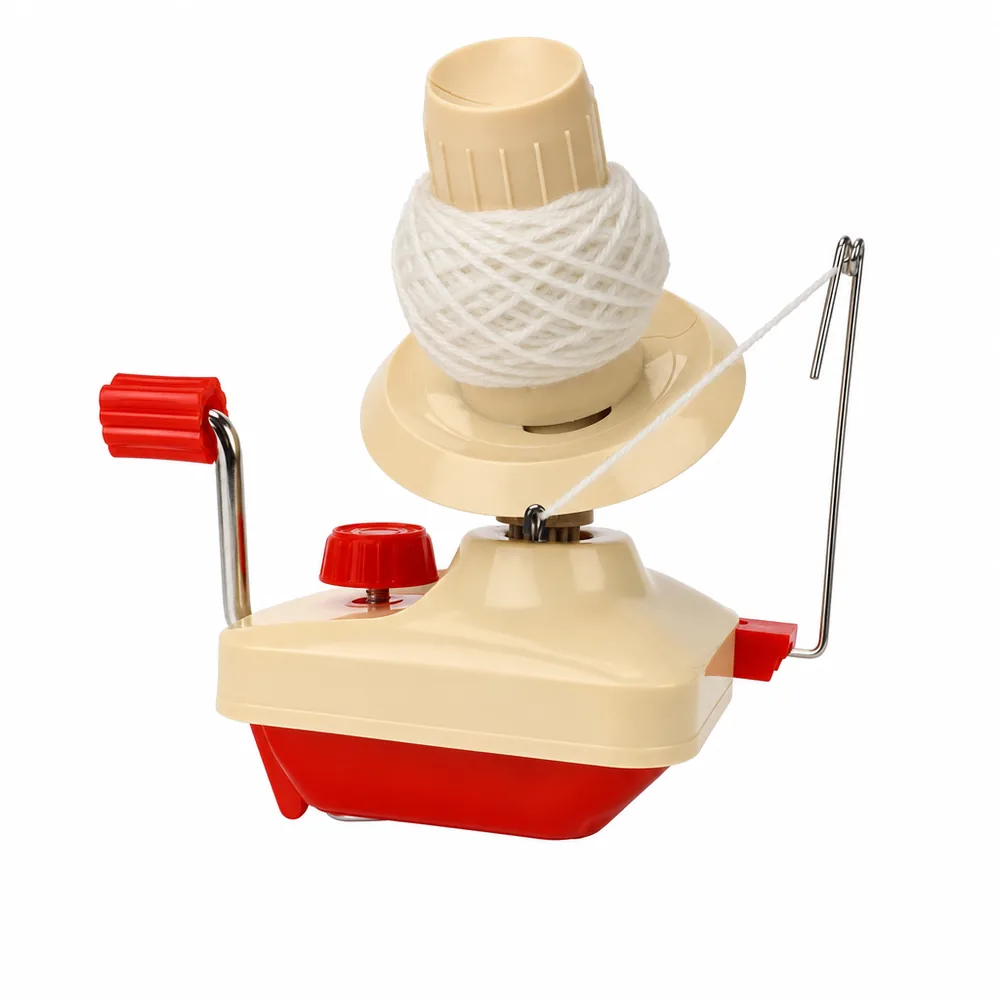
The second thing it fixes is the direction the yarn leaves the ball. A hand-wound ball has to be unwrapped from the outside, which means the ball itself has to turn. On a hard floor it rolls, picks up dust, and drags the working strand under a chair leg. The ball a winder makes is hollow in the middle, and the tail you started with is left sitting in that hollow. You pull from the center, the ball never moves, and the last yard comes out as cleanly as the first.
The third thing is simply time. A commercial hank has to be opened, held taut and wound before you can knit a single stitch, and doing that with a chair back or a helper's forearms is where most tangles are born. With a swift holding the loop and the winder pulling on it, the same hank becomes a ball in the time it takes to finish a cup of coffee. If you want the full sequence, the how to use a yarn swift guide walks through it.
| Ball type | How it feeds | What happens on the table | Tension on the yarn |
|---|---|---|---|
| Hand-wound ball | From the outside | Rolls away, needs a bowl or a bag | Increases as the ball grows |
| Ball from a winder | From the center | Sits flat, does not move | Stays as wound, layers cross |
| Factory pull skein | From the center, in theory | Collapses once half used | Set at the factory, not by you |
Six named parts, one clockwise turn
"Set spindle into geared base by aligning notches. While holding geared base, turn spindle clockwise to secure." Skeinwright ball winder assembly instruction, 2026
That sentence is worth reading twice, because the two halves of it are the two mistakes people make. Aligning the notches is what stops the spindle from sitting proud and wobbling; holding the geared base is what stops the whole unit rotating with the spindle instead of locking onto it. Turn it until it stops turning, not until it feels tight, and never force it past that point.
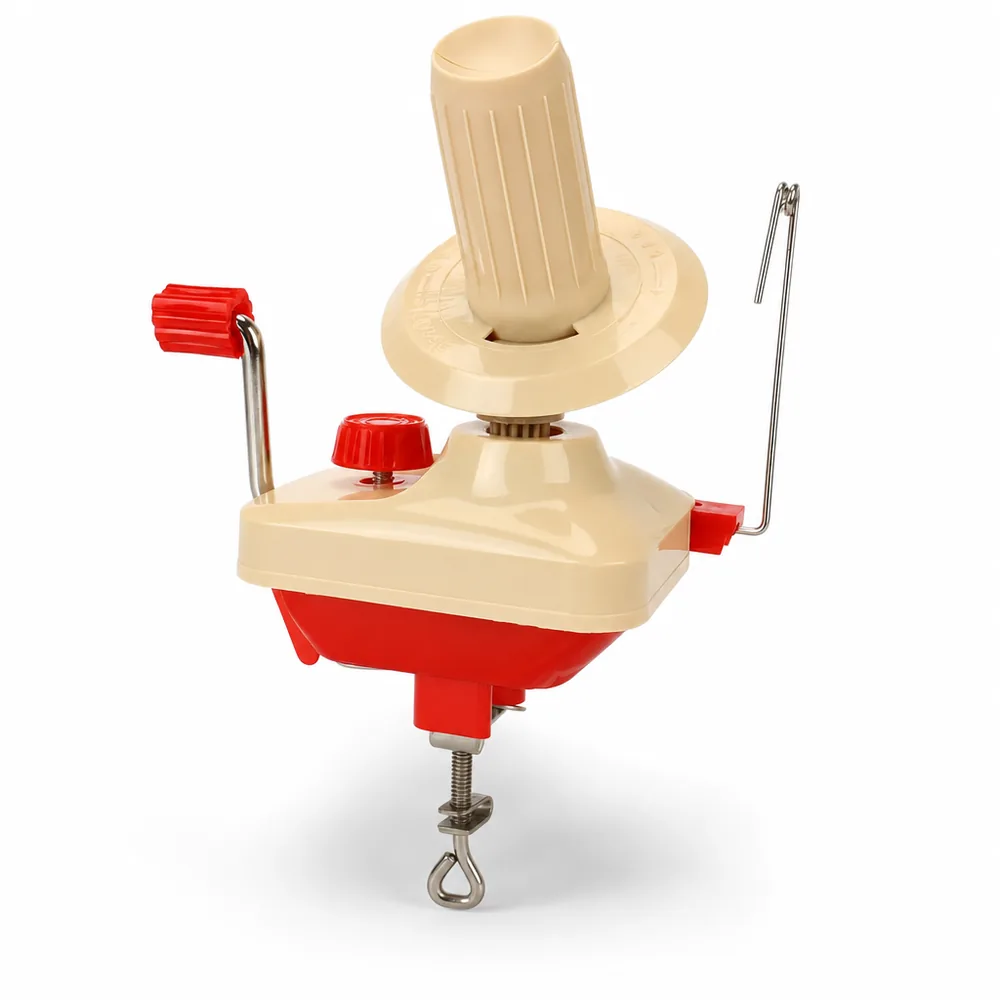
The spec sheet names six parts. Knowing which is which makes every later instruction on this page readable, and it makes a support message to our contact page far quicker to answer if something ever arrives damaged.
| Part | Where it sits | What it is for |
|---|---|---|
| Spindle | Top, vertical | Carries the ball as it builds and gives it the tapered shape |
| Geared base | Body of the winder | Converts one turn of the handle into the spindle's faster rotation |
| Handle | Side, on the crank arm | The grip you actually turn |
| Knob | On the crank arm | Sets the crank against the geared base |
| Yarn guide | Arm reaching out from the body | Feeds the strand in at a fixed angle so the layers cross |
| Clamp | Underneath | Screws the winder to a table edge so it cannot walk |
How to wind a ball, step by step
- Clamp low and clamp firm. Choose an edge you can reach from above and below, and tighten the screw until the body no longer rocks when you push it. A winder that shifts a quarter inch on every turn will throw the layers off and make a lopsided ball.
- Open the hank first. Untwist it, find the two loose ends and cut the ties. If the yarn came as a twisted hank, this is the point where the umbrella swift earns its place: the loop goes over its ribs and stays open by itself.
- Thread the yarn guide. Run the strand through the guide arm so it approaches the spindle at the angle the guide sets. Skipping the guide is the single fastest way to build a ball that collapses.
- Anchor the tail. Tuck the end into the slot at the top of the spindle and leave a few inches hanging inside. That hanging end becomes the center pull.
- Crank at a steady, unhurried speed. Keep your free hand a foot back from the guide, resting on the strand rather than gripping it. You are feeling for resistance, not applying it.
- Stop for every knot. Commercial hanks are joined. When you feel one, stop, cut, and start the second half as a new ball rather than winding a lump into the middle of the first.
- Lift the ball straight up. Do not twist it off. Straight up keeps the hollow center intact, which is the whole point of the exercise.
Working with something slippery like silk or bamboo? Wind slower and stop more often. Those fibers hold less friction against each other, so the outer layers can slide if the ball is built at speed. Read our how we test page for the criteria behind these pages.
Why a winder wants a swift next to it
This is the part of the story that gets sold as a marketing bundle everywhere else. It is not. The spec sheet describes the umbrella swift's purpose as unwinding a twisted hank for use with a winder. The two products come from two different factories with no relationship to each other, and both describe the same workflow. That is as close to independent confirmation as this category gets.
In practice, the swift takes the load and the winder takes the shape. Without a swift you are the swift: your knees, a chair back, or a patient second person holding the loop. Every one of those loses tension unevenly, and uneven tension is what folds a hank into a nest. The swift and winder combination exists because neither tool finishes the job alone.
We read the winder's ratings one by one before listing it
Averages hide things, so we did not take the headline star score at face value. We pulled the whole rating history for this winder and read the four and five star ratings individually, along with every photo attached to them. Fifty distinct buyers had uploaded images. Seventeen of those photos survived a visual check, which is the part nobody talks about: the rest showed competitor packaging, phone screenshots, sealed parcels or a wooden stand that is a different product altogether.
| What we looked at | Finding | What we did about it |
|---|---|---|
| Ratings of four stars and up | 285, averaging 4.9 | This is the figure we display, and the only one we display |
| Buyer photos attached to those ratings | 50 distinct uploaders | Opened and viewed every one |
| Photos that actually show this product in use | 17 | Kept for the reviews page |
| Photos showing a third-party brand or the wrong item | The remainder | Discarded, never published |
We publish ratings of four stars and up. That is a deliberate editorial choice, not a claim that no buyer has ever been unhappy with a hand crank winder.
The figures behind this listing
Height of the winder, 19 cm, with 5.35 in of length and 3.54 in of width
— Skeinwright specification sheet, 2026
Parts the spec sheet names: spindle, yarn guide, knob, geared base, handle and clamp
— Parts diagram, 2026
Verified buyer ratings of four stars and up, averaging 4.9 out of 5
— Skeinwright audit of the rating history, 2026
Standard yarn weight categories, from Lace to Jumbo, that a winder has to handle
The eight weight categories matter more than they sound. A winder that only handles worsted is no use to a lace knitter, and the reason a hand crank works across the range is that you set the speed yourself. A motor cannot tell the difference between cobweb lace and jumbo roving. Your hand can.
Everything the spec sheet publishes
| Height | 7.48 in (19 cm) |
|---|---|
| Length | 5.35 in (13.6 cm) |
| Width | 3.54 in (9 cm) |
| Drive | Hand crank onto a geared base |
| Mounting | Integrated screw clamp for a table edge |
| Colour | Cream body with red crank and detailing |
| Named parts | Spindle, yarn guide, knob, geared base, handle, clamp |
| Price | $24.95, or $57.95 in the set with the swift |
Need a figure that is not on this page? Ask us at our contact page and we will get it for you. Delivery, returns and the countries we ship to are set out in our shipping policy and refund policy.
Reviewed July 2026. See how we test and about Skeinwright.
Yarn winder questions, answered
What does a yarn winder actually do?
A yarn winder wraps loose yarn into a flat-bottomed center-pull ball. You feed the strand through the yarn guide, hook it on the spindle and turn the crank. The winder lays the yarn in crossing layers so the ball keeps its shape and feeds from the middle without rolling across the floor.
How do I assemble the Skeinwright ball winder?
The spec sheet gives one instruction: set the spindle into the geared base by aligning the notches, then, while holding the geared base, turn the spindle clockwise to secure it. After that you fit the yarn guide arm and tighten the table clamp under your work surface. No tools are needed.
Do I need a swift as well as a yarn winder?
For a twisted hank, yes. The winder pulls yarn faster than you can feed it by hand, so something has to hold the loop open and rotate with it. That is the swift. For yarn that is already a loose ball or a cake, the winder works on its own.
Is this a hand crank yarn winder or an electric one?
It is hand crank. You turn the handle yourself, which means you set the speed and you feel it the moment the strand snags or a knot arrives. There is no motor, no cord and no battery, so nothing on it can burn out mid-skein.
How big is the winder and where does it clamp?
It measures 7.48 in (19 cm) tall, 5.35 in (13.6 cm) long and 3.54 in (9 cm) wide. The integrated clamp screws onto a table edge, a desk, a kitchen counter overhang or a sturdy shelf. It needs an edge it can grip from above and below.
Can I buy the winder and the swift together?
Yes. The Swift plus Winder Set is $57.95 instead of $94.90 at full price. Both items ship together, free, and arrive in 6 to 10 business days. The set is the option most buyers pick because the two tools do two halves of one job.
The rest of the setup
Umbrella swift
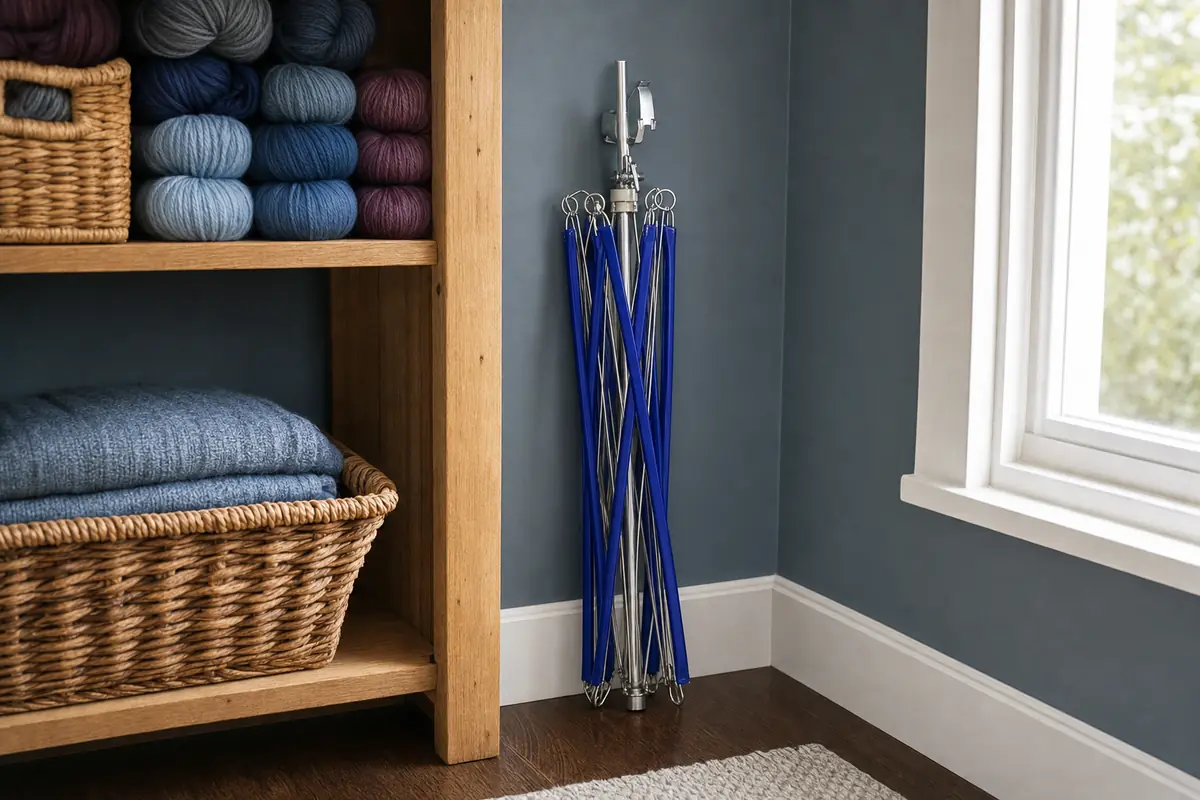
The tool that holds the hank open while the winder pulls on it. Iron skeleton, opens to 21.65 in (55 cm) across, folds flat for the cupboard.
Swift and winder set
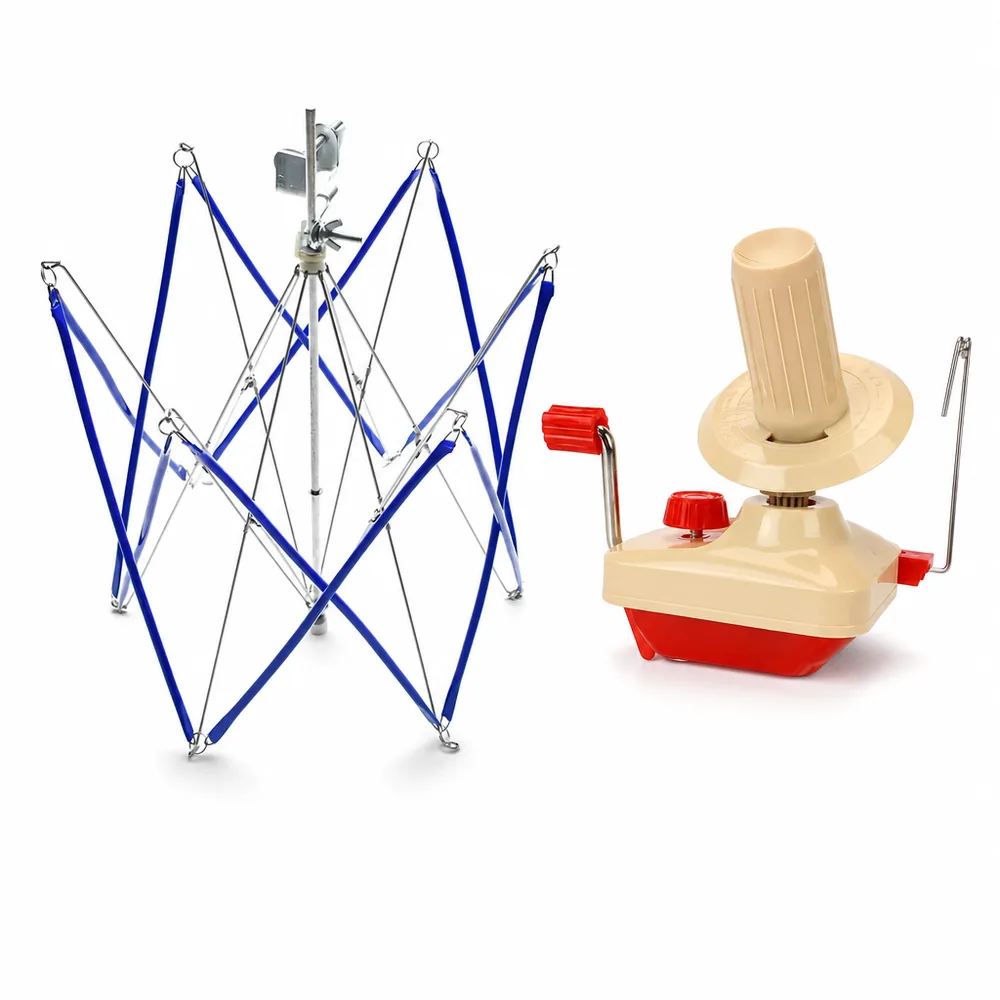
Both tools together for $57.95 instead of $94.90. One delivery, one clamp-on session, skein to center-pull ball.
Guides
How to open a hank without a tangle, what to do when the yarn snags and why center-pull balls behave. Start with the yarn swift walkthrough.